CVE-2020-1472
Netlogon Elevation of Privilege (Zerologon)
AffectedTested and vulnerable1 asset confirmed
CyberVision identifies the flaws that give an attack its entry, orders remediation by business impact, and drives execution to closure. Artificial intelligence performs the technical function most organizations cannot hire.
CyberVision — AI assistant
check the security of my company
Consolidating every monitoring front.
24
7
IndexThe grade rises as corrections are closed.
what should I fix first?
Ordering by business impact.
OrderedQueue reordered by impact and likelihood.
assess this week’s security bulletins
Cross-checking bulletins against your inventory and testing each one.
CVE-2020-1472
Netlogon Elevation of Privilege (Zerologon)
AffectedTested and vulnerable1 asset confirmed
CVE-2019-19781
Citrix ADC Directory Traversal
Not exposedTested, the flaw is not presentNo asset matched
PrioritizedWhatever does not affect you leaves the queue.
generate this month’s executive report
Consolidating the period and drafting the document.
ExecutivePDF
Executive overview — August 2026
Executive summary
Security posture and index evolution
Critical risks and remediation deadlines
Comparison with the previous period
ReadyAvailable to print and download.
assess our LGPD compliance
Measuring the required technical controls.
DocumentedTechnical evidence exported for audit.
check the mail server
Analyzing authentication, delivery, and reputation.
In remediationTwo DNS adjustments opened for execution.
what would the impact of an attack on the file server be?
Simulating the reach from that asset.
6systems would stop with it
In remediationSegment isolation entered the queue.
how are the corrections progressing?
Checking the tickets in the remediation plan.
76%of the plan completed
TrackedOwner of the overdue item notified.
are we vulnerable to ransomware?
Checking the vectors most used in this attack.
In remediationThree corrections opened for the main vector.
assess the company’s resilience
Testing recovery and continuity.
RecommendedRestoration test scheduled for this week.
schedule a weekly scan of the external network
Creating the routine in the scheduler.
Weekly external scanScan
ScheduledReport delivered at the end of each run.
generate the incident response policy
Drafting the document for your environment.
ProcessPDF
Incident Response Policy
Incident classification
Escalation and owners
Containment and eradication
Notification of the ANPD
ReadyDocument available for review and signature.
Illustrative demonstration of the CyberVision interface
React or fortify
Antivirus, firewall, and monitoring all start from the same premise: the attack will happen, and what remains is to contain it. The alternative — eliminating the flaw before an incident exists — has always been cheaper and more effective. And it has always met the same limit: remediation demands deep technical knowledge, applied continuously, which most organizations cannot sustain.
Detects and blocks what is already under way. Necessary, yet always one step behind: it presumes the door stays open.
Removes the door before anyone looks for it. A correction in a planned window, with no service interruption and no notification to clients or authorities.
A scheduled update costs a fraction of halted operations, emergency specialists, notification of the ANPD, and the contract that is not renewed.
That limit is what artificial intelligence removes. CyberVision performs the fortification: it finds the flaw, sets the order, and drives the correction.
The missing layer
Command center
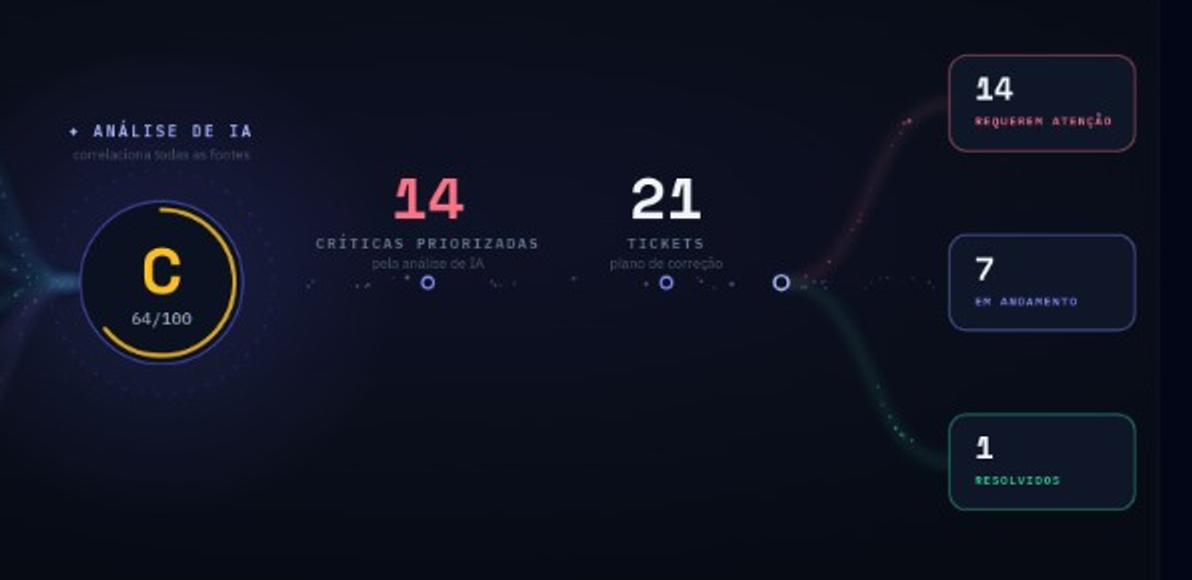
A grade from A to F composed over the six monitored fronts from the controls of NIST CSF 2.0 and CIS Controls v8, with every technical finding weighted by CVSS severity and asset criticality. Alongside the grade, the asset inventory, the risks requiring immediate action, and the order of execution set by business impact.
The organization’s security position becomes measurable against a recognized reference.
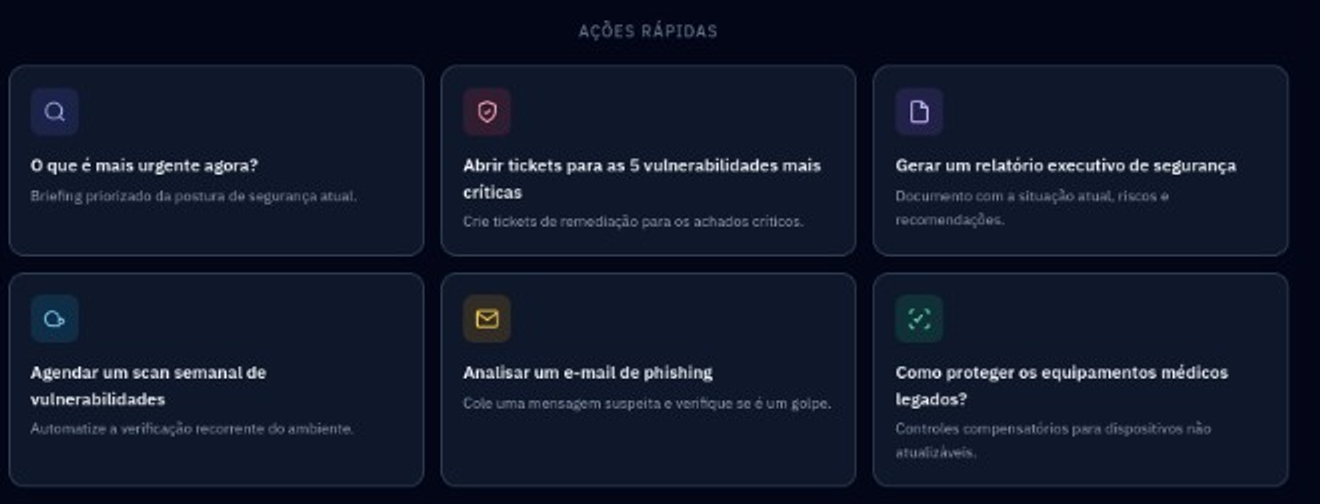
Artificial intelligence assistant
The request is written as it would be addressed to a professional: which risk to treat first, generate the board report, assess a suspicious message, schedule recurring scans. The platform executes, presents the result, and opens the corresponding tickets.
Tasks that would require a consultant are executed in minutes, with no prior knowledge.
Agent team
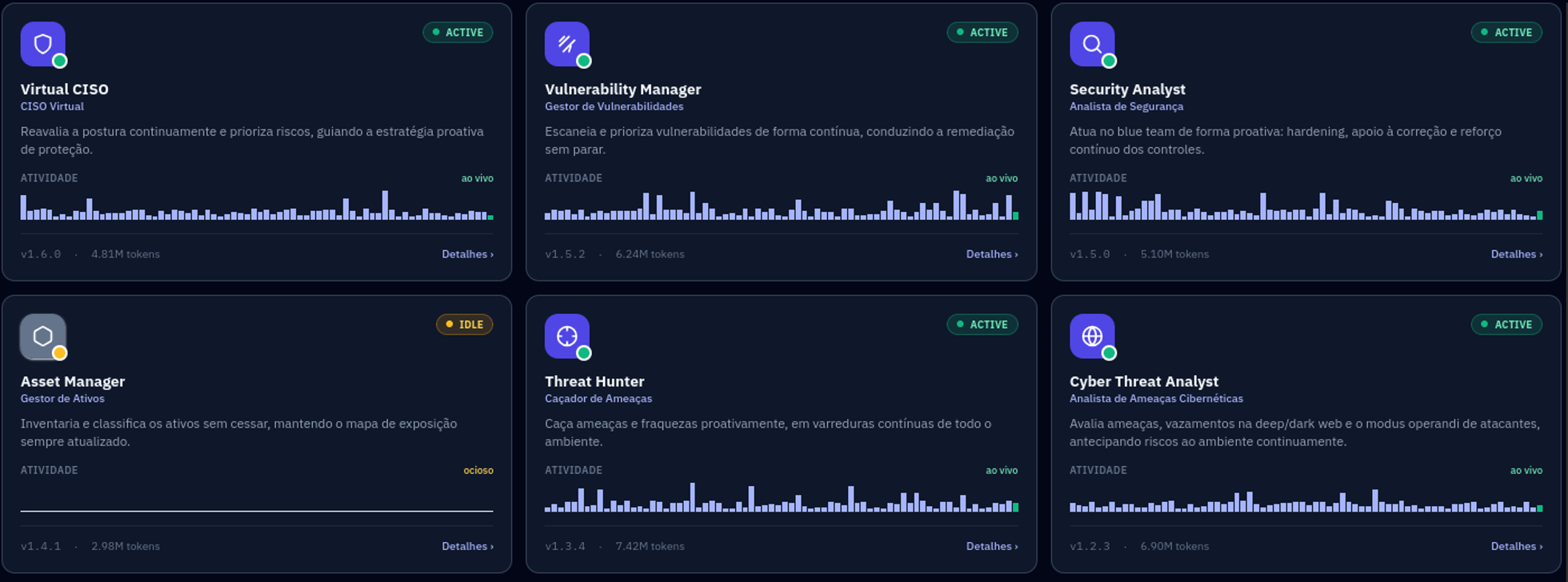
Virtual CISO, vulnerability manager, security analyst, asset manager, threat hunter, cyber threat analyst, compliance analyst, and security coordinator. Each agent performs its function without interruption. It is this installed capacity — unavailable to organizations of this size through hiring — that makes continuous remediation viable.
Permanent analysis across the whole environment, with no gap between the scan and the reading of its result.
Emerging Threats
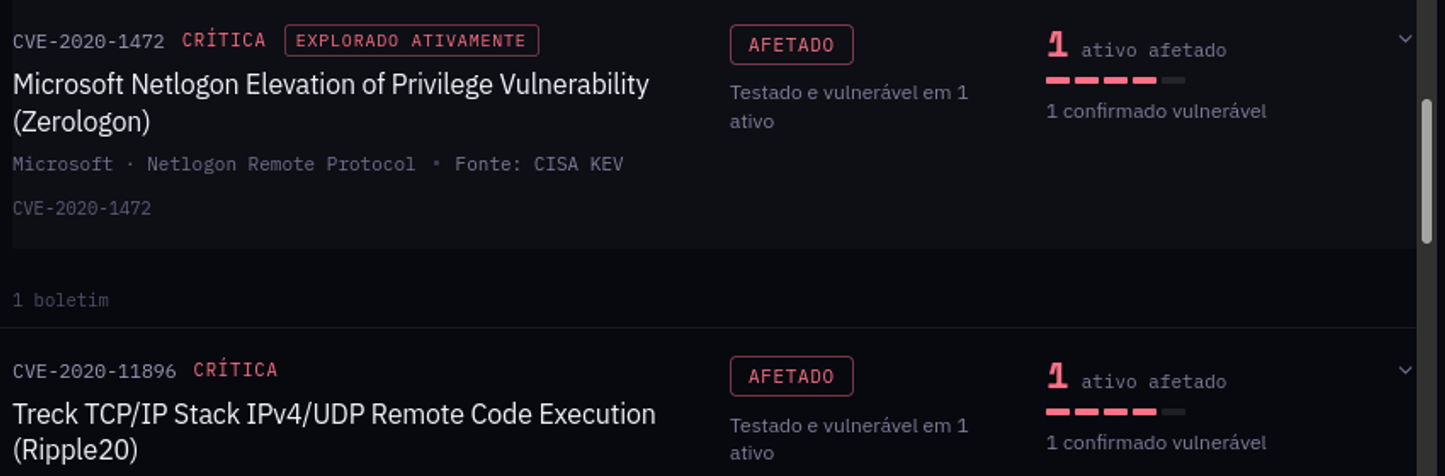
When a serious flaw is disclosed, the platform cross-checks the bulletin against the inventory and runs the available test on the organization’s own assets. The verdict is objective: affected, with the confirmed assets, or not exposed, when verification demonstrates the flaw is not present. Whatever does not apply leaves the queue.
The decision stops depending on headlines and starts depending on verification.
Governance
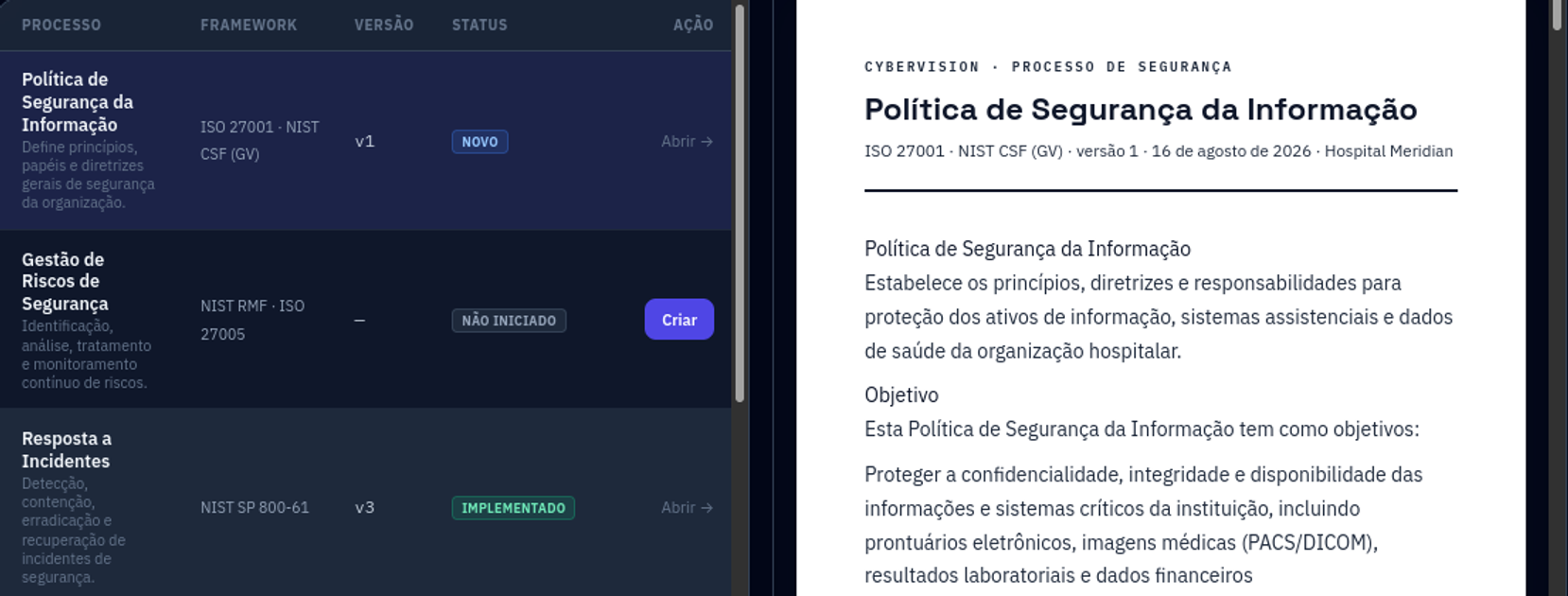
Fourteen processes, each carrying its framework reference — ISO 27001, NIST CSF, NIST SP 800-61, NIST SP 800-63, NIST RMF, ISO 27005, and CIS Controls — drafted by artificial intelligence against the organization’s own infrastructure, with a version and an implementation status. The grade measures the state of the environment; these documents are the formal evidence that accompanies a client questionnaire, an insurer requirement, or an audit.
Requests for evidence are answered with a referenced document rather than a self-declaration.
Coverage
An intrusion attempt does not select one path: it covers all of them. These are the six fronts kept under permanent verification.
Connected servers, workstations, and devices — including assets absent from the formal inventory.
The entire surface visible from the internet: ports, published services, and entry points.
Known flaws in operating systems, with the public identifier and the applicable correction.
Bulletins disclosed today, verified the same day against the organization’s assets.
Excessive permissions, storage without access restriction, and unprotected backup routines.
Corporate credentials circulating in restricted forums and marketplaces, before they are used.
Mechanism
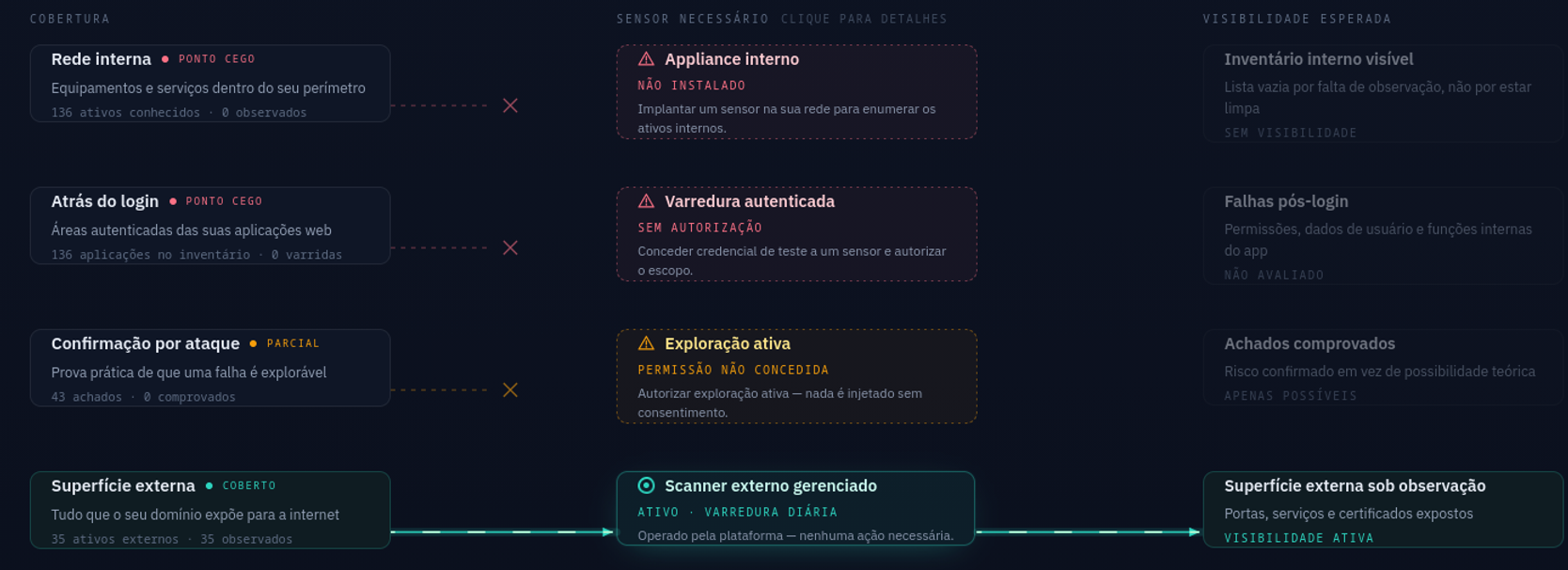
The platform operates through sensors whose scope is authorized by contract. Each dimension of the environment requires a specific sensor and yields a specific visibility. The organization sees that entire chain, including the dimensions that remain uncovered.
Scope
Everything the organization’s domains expose to the internet.
Sensor
Managed external scanner
Active · daily scan
Operated by CyberSeven. Nothing to install.
Visibility
Exposed ports, services, and certificates under observation.
Scope
Equipment and services inside the perimeter.
Sensor
Internal appliance
Requires installation
Runs on one machine inside the network, restricted to the authorized IP ranges. All communication is initiated by the appliance over outbound HTTPS: no inbound port is opened on the perimeter.
Visibility
Internal inventory and flaws on the connected assets.
Scope
Web applications in their authenticated areas.
Sensor
Authenticated scan
Requires authorization
Depends on a test credential granted by the organization and on a scope authorized in writing.
Visibility
Permissions, user data, and internal application functions.
Scope
Practical proof that a flaw is exploitable.
Sensor
Active exploitation
Requires express permission
Nothing is injected into the environment without recorded consent.
Visibility
Confirmed risk in place of theoretical possibility.
Evaluation
The organization has no dedicated security professional.
That is the scenario the platform was built for. The stage requiring expertise is performed by artificial intelligence — identifying, correlating, and prioritizing — and what results is a remediation plan in clear terms. Execution falls to the IT team, the infrastructure vendor, or CyberSeven under the Managed plan.
The available security budget is limited.
Contracting follows the size of the environment: it considers the monitored assets and the enabled modules, not a fixed corporate bundle. The pertinent comparison is not another tool, but the cost of one day of interrupted operations.
The team has no technical background in security.
It is not a requirement. The technical analysis is performed by artificial intelligence, which presents the recommended action for each item in order of priority. Interaction with the platform takes place in natural language.
The organization already uses antivirus and a firewall.
Both remain necessary and act on containment: antivirus over malicious files, firewall over network traffic. Neither reports where the organization is exposed today, nor which correction should be executed first. That is the field of proactive fortification, the function of CyberVision.
How is the organization’s data handled?
The monitoring scope is defined in contract and every scan depends on formal authorization. The platform collects technical configuration and exposure data — it does not access the contents of mailboxes, working files, or client databases.
Industries
The first door to close is the one that leads to what the organization cannot lose — and that varies by activity.
Unavailable records interrupt care. Medical equipment without manufacturer support cannot be patched and requires protection through other controls.
Accounting, law, and consulting operate under contractual confidentiality. A leak compromises the client relationship before it compromises revenue.
Platform unavailability suspends revenue for every hour down. The customer database is the asset of highest value and highest exposure.
A stopped line has a known hourly cost. Production control systems and supplier integrations define continuity.
Implementation
The evaluation runs against the organization’s real infrastructure, not a demonstration environment. At its conclusion, the contracting decision is made on the organization’s own results.
Day 1
Registration of contact and organization details. No credit card is required during the evaluation phase.
Day 2
A thirty-minute session to survey the environment, formally define the monitoring scope, and grant the required access.
First week
Delivery of the initial security index and the prioritized risk queue, with asset identification and a recommended action per item.
Conclusion
The organization decides based on results obtained in its own environment. The technical report for the period remains with the client.
In one week, over the organization’s real infrastructure, the result is the security grade and the order of remediation set by business impact. No credit card and no commitment: when the evaluation ends, the technical report for the period remains with the organization.